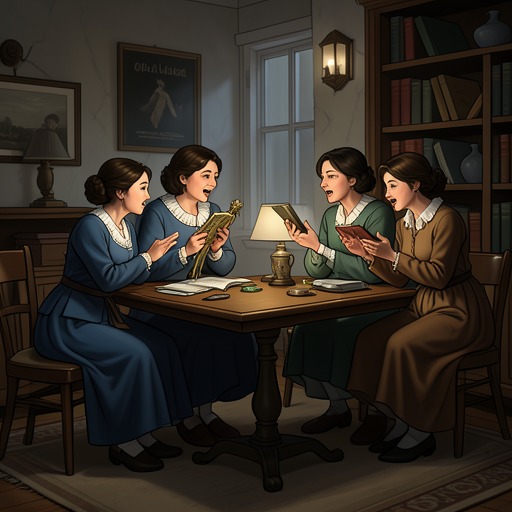
Pickwick Club accepts Laurie
Little WomenThe admission of Theodore Laurence to the Pickwick Club is a small domestic ceremony with large consequences: it converts the March sisters’ private imitation of The Pickwick Club into an inclusive social world shared with their young neighbor. Theodore Laurence enters not as a passive guest but as a chosen honorary member, bringing humor, literary energy, and a gift that turns the garden boundary into a route for continuing communication. The event establishes the neighborly intimacy that will bind the March family and the Laurence family through later generosity, companionship, and crisis.
The Club Before Theodore Laurence
The Pickwick Club is organized by the four March sisters as a miniature literary society, complete with offices, parliamentary manners, badges, dramatic names, and a paper. Its imaginative structure allows the girls to rehearse adult institutions while remaining within the protected space of the March family home. The club is at once theatrical and serious: its members write, debate, perform, and judge one another’s work, making literature a form of play and a means of self-definition.
The proposal to admit Theodore Laurence arises from this mixture of affection and institution-building. At a formal meeting, Mr. Snodgrass argues that the new member would deserve the honor, be grateful for it, and add to the club’s spirit and literary value. The proposal is not merely a joke at Theodore Laurence’s expense. It recognizes that his presence has already begun to enlarge the sisters’ social and imaginative lives, even though he belongs to the neighboring Laurence mansion rather than to their household.
The Vote and the Surprise Admission
The club initially hesitates, but Elizabeth March breaks through the anxiety with an emphatic appeal to admit Theodore Laurence and, if he wished, his grandfather James Laurence as well. Her intervention changes the emotional atmosphere of the meeting. Josephine March immediately leaves her seat to shake hands with Elizabeth March in approval, and a second vote is called. Three voices answer in favor, formally making Theodore Laurence an honorary member.
The ceremony then reveals its comic deception. Josephine March throws open the closet door and displays Theodore Laurence sitting on a rag bag, flushed and laughing because he has been listening to the proceedings. The other girls protest that Josephine March has betrayed them, but the surprise quickly becomes an installation ceremony: she leads Theodore Laurence forward, gives him a chair and a badge, and places him among the members. His participation is therefore both hidden and public. He has been an object of discussion, then becomes the person capable of answering it with theatrical poise.
Theodore Laurence accepts the role under the club’s rules of performance, introducing himself in the character of Sam Weller and addressing the presiding members with comic formality. His readiness matters because it proves that he can enter the sisters’ imaginative language without belittling it. Rather than exposing the club as childish, he strengthens its fiction from within. His admission is consequently a test of social tact as much as a comic episode: he belongs because he understands the game and respects the players.
The Hedge Post Office
As a token of gratitude, Theodore Laurence establishes a post office in the hedge at the lower corner of the garden. The structure is an adapted martin house, with its door stopped up, its roof opened, and padlocks fitted to make it suitable for the exchange of letters, manuscripts, books, and bundles. Each “nation” receives a key, turning the garden into a symbolic map of neighboring powers whose separation is maintained only for the pleasure of correspondence.
The gift gives the new membership an enduring material form. The club’s meetings may end, but the hedge post office remains available for messages and objects to travel between the March family home and the Laurence mansion. It also makes communication reciprocal rather than one-sided: Theodore Laurence does not simply receive entry into the sisters’ circle; he creates an institution through which all of them can send, answer, tease, and surprise one another.
The post office soon carries an astonishing variety of things, including poetry, pickles, garden seeds, long letters, music, gingerbread, invitations, scoldings, and even puppies. James Laurence enjoys the arrangement and sends odd bundles, mysterious messages, and comic telegrams of his own. The institution therefore extends the children’s game into the adults’ world without losing its playful character. A gardener’s love letter, mistakenly placed in Josephine March’s care, becomes another joke, while the narrator’s retrospective observation that the little post office will later hold many love letters gives the episode a clear note of foreshadowing.
Consequences for the Two Families
No one regrets Theodore Laurence’s admission. He proves devoted, well behaved, and jovial, adding spirit to the meetings and a new tone to the club’s paper. His speeches and contributions range from patriotic and classical to comic and dramatic, but never sentimental; Josephine March admires them enough to remodel her own writing after them. His influence is thus artistic as well as social. He becomes a collaborator whose presence alters what the sisters produce.
The event also prepares the larger pattern of exchange between the two households. James Laurence’s later generosity is presented as a response to the March sisters’ Christmas sacrifice: after the girls give their breakfast to a poor woman and her six children, he sends them a supper because Hannah Mullet has told one of his servants about their charity. He already knows that their act matters, but the club and its post office have made friendly feeling visible across the boundary. The old gentleman’s formal distance begins to give way to active neighborliness.
That movement continues when James Laurence sends Elizabeth March a little cabinet piano, addressed directly to her. The gift is especially fitting because music is Elizabeth March’s comfort and because it answers the gentleness with which she has entered the Laurence family’s orbit. Later, when Mr. March is dangerously ill, James Laurence offers provisions, protection, and every comfort he can think of for the invalid, while John Brooke helps arrange Mrs. March’s journey. The family’s response to the Laurence household is likewise practical and emotional: affection becomes assistance when illness and wartime separation test the March family.
Narrative and Thematic Significance
The admission scene turns a boundary into a meeting place. The hedge initially marks the physical separation between households, but Theodore Laurence’s post office makes that separation permeable without erasing it. Letters, manuscripts, food, music, and jokes pass through the small structure, allowing intimacy to grow through repeated acts rather than through a single declaration. The event therefore dramatizes how friendship is made: by invitation, reciprocal gifts, shared play, and dependable access.
The episode also places literature at the center of social formation. The sisters’ club is an imitation, but imitation becomes creative when Theodore Laurence joins it. The Pickwick Club provides the role-play, the badge, the parliamentary language, and the paper; the real emotional achievement lies in making room for someone previously outside the circle. The club’s fiction becomes a rehearsal for a wider fellowship in which difference of household, age, and social position can be negotiated through humor.
Finally, the event foreshadows the lasting significance of Theodore Laurence’s relationship with the March family. His admission is comic and apparently minor, yet it creates the customs and channels through which future loyalties can operate. The post office’s later association with love letters makes the scene look forward, while the surrounding episodes of gifts, illness, protection, and family reunion show how a children’s game can become the first visible architecture of a lifelong friendship.